.png)
Cybersecurity Solutions / VPN App Development
Developing...

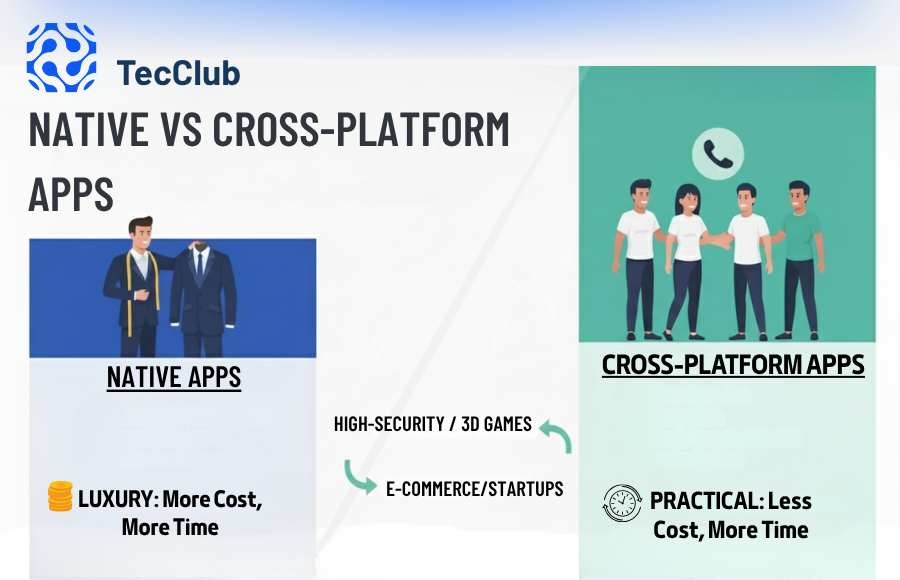
When planning to build a mobile app, one of the first big decisions is: Should you go native or cross-platform?
It’s not a small choice. The path you pick affects cost, time-to-market, performance, and user experience. Let’s break it down in simple terms so you can decide what’s best for your business.
Native apps are built specifically for one operating system—iOS or Android. Developers use programming languages and tools tailored to each platform:
iOS: Swift or Objective-C with Apple’s Xcode.
Android: Kotlin or Java with Android Studio.
Best performance: Apps run smoothly because they’re optimized for the platform.
Seamless user experience: Looks and feels natural to users of that OS.
Access to all device features: Camera, GPS, sensors—everything works flawlessly.
Better scalability: Easy to expand as the app grows.
Higher costs: You need separate teams for iOS and Android.
Longer development time: Building two versions takes more effort.
Cross-platform apps are built using one codebase for multiple platforms. Popular frameworks include Flutter, React Native, and Xamarin.
Faster development: Write once, run on both iOS and Android.
Lower costs: A single team builds both versions.
Quicker updates: One codebase makes bug fixes and upgrades easier.
Good performance (with modern tools): Frameworks like Flutter have narrowed the gap with native apps.
Slightly less performance: Heavy apps (like 3D games) may lag compared to native.
Limited access to some device features: Not every feature is available out-of-the-box.
UI/UX inconsistencies: May not feel 100% “native” to every user.
Performance is your top priority (e.g., gaming, AR, banking).
You want the smoothest user experience possible.
Budget and time aren’t major constraints.
You want to launch quickly on both iOS and Android.
Budget is limited, but you still need wide reach.
Your app is relatively simple (e.g., e-commerce, booking, social apps).
Imagine a startup launching a food delivery app. They need speed, affordability, and wide reach. Cross-platform is the obvious choice.
Now picture a bank building a secure mobile app with complex features like biometric authentication and real-time updates. Native development is the safer bet for performance and security.
There’s no one-size-fits-all answer. The “right” choice depends on your business goals, budget, and user needs.
Go native if you want the best possible performance and user experience.
Go cross-platform if you want faster, more affordable development without sacrificing too much quality.
Either way, making an informed decision early will save you time, money, and frustration down the road.



© TecClub 2025 | All Rights Reserved